Cyber threat level today
Clear
A quiet day by the past year’s standard: most signals are at or below their usual level.
- Thu 12Showers5 pts
- Fri 13Cloudy4 pts
- Sat 14Showers6 pts
- Sun 15Showers5 pts
- Mon 16Storm7 pts
- Tue 17Clear1 pt
- TodayClear2 pts
Share today’s forecast on WhatsApp · Image for LinkedIn · for status (9:16)
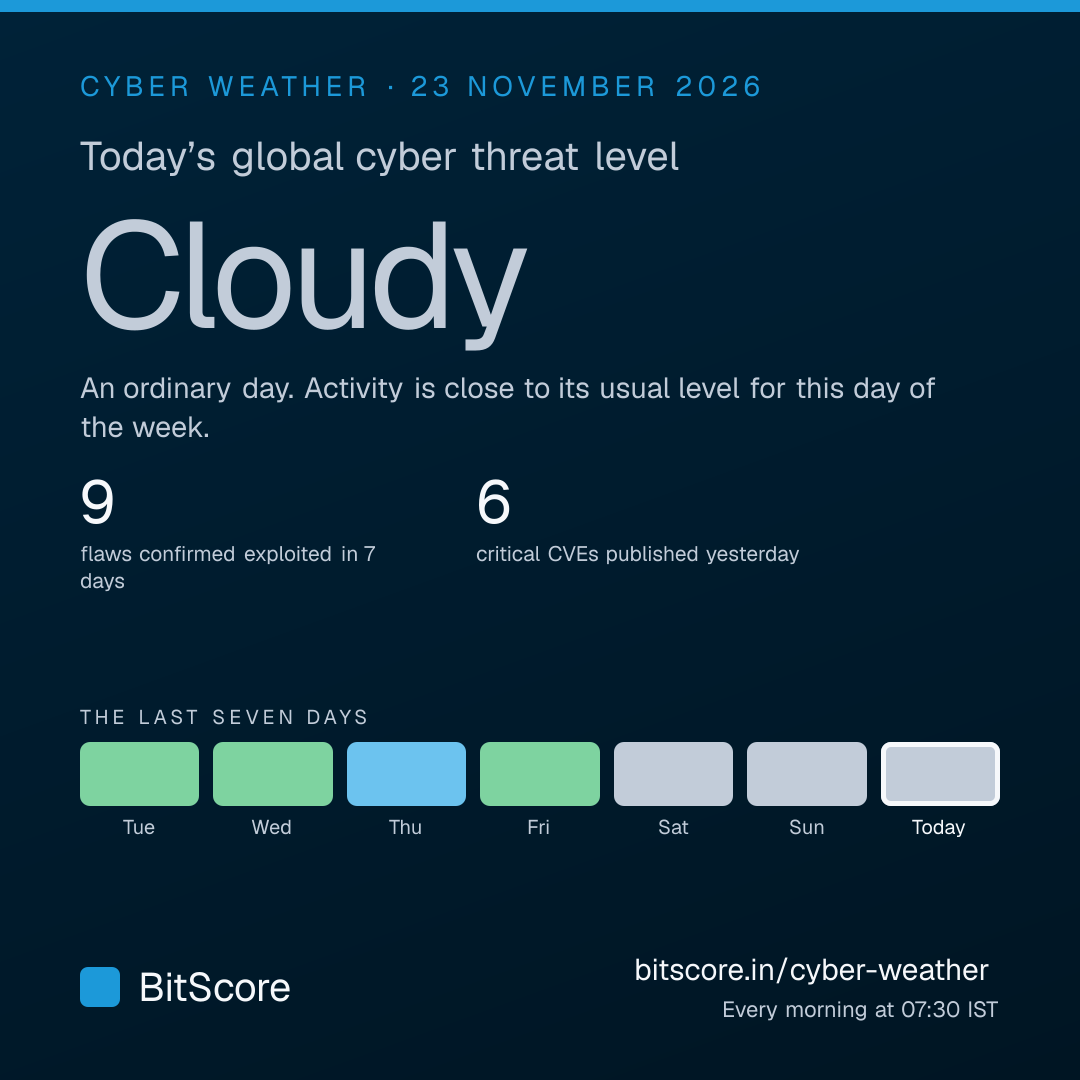
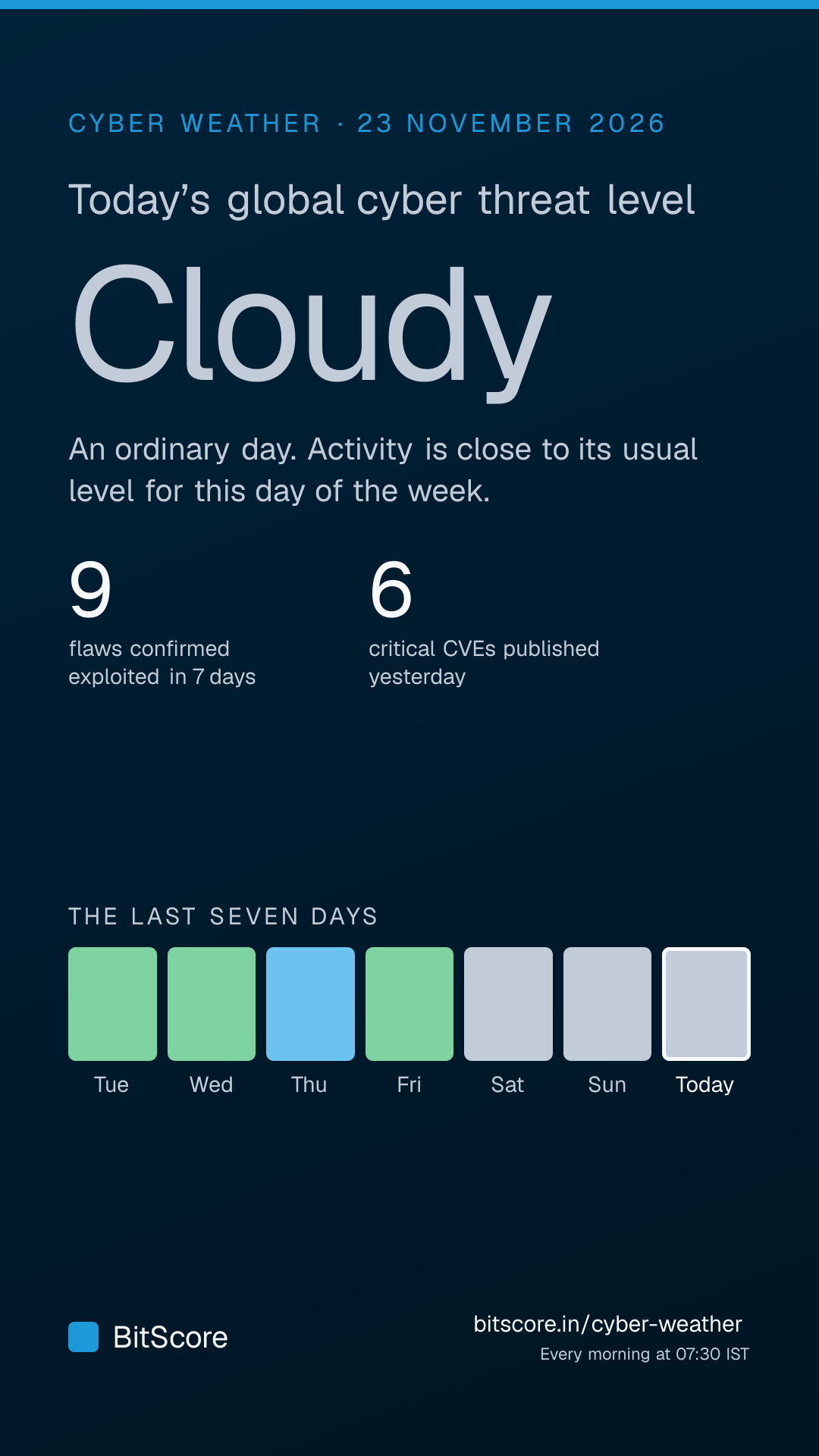
Today’s forecast
Unchanged from yesterday; 1 pt then, 2 pts now.
CISA added 1 exploited flaw on 17 Nov: Perforce Puppet Enterprise. 3 in the last seven days, down from 8 a day earlier.
chance of lightning
CISA added newly exploited flaws on 60% of Wednesdays over the past year.
chance of lightning
CISA added newly exploited flaws on 52% of Thursdays over the past year.
- Check whether you run Perforce Puppet Enterprise: newly confirmed as exploited in the wild.
- Check whether you are exposed to CVE-2026-6875: its chance of exploitation rose from 1% to 78% this week, ahead of any CISA listing. Read the CVE
- Port 23, Telnet, old unencrypted remote login, is among the five most-scanned on the internet. Make sure nothing of yours answers on it. Check your domain →
That’s the weather for everyone. Your own organisation’s rating — independent, on the 250–900 scale — is free.
My weather
Rows added since your last visit are marked new. Nothing leaves your browser.
Watch the vendors you run
Pick up to 12 vendors and this card lists only what names them: exploited flaws, critical CVEs and edge-device advisories. Your list stays in this browser. Start from a common set, then edit it:
Choose vendors
Today’s readings
Five instruments set the condition. Four earn up to three points each by where they sit against their own history — critical CVEs and attack traffic like for like by weekday, so a quiet Sunday is compared with other Sundays. The Infocon level adds two, four or six when SANS raises it. The pips show the points; choose an instrument for its detail.
Newly exploited flaws, last 7 days
- 17 NovCVE-2026-115731 · Perforce Puppet Enterprise
- 13 NovCVE-2026-114713 · UnrealIRCd UnrealIRCdautomatable
- 13 NovCVE-2026-123039 · Check Point Multiple Products
Confirmed as exploited in the wild. Patch these before anything else, starting with any CISA marks automatable: one attacker can hit them across thousands of hosts.
How widely is this software deployed? Each vendor’s footprint on Bitsight Groma: Perforce · UnrealIRCd · Check Point.
Critical CVEs published
- 10.0CVE-2026-100397 · rucio rucio
- 10.0CVE-2026-114784 · Oracle Corporation Oracle Business Intelligence Enterprise Edition
- 10.0CVE-2026-114824 · Oracle Corporation Oracle Platform Security for Java
- 10.0CVE-2026-114835 · Oracle Corporation Oracle Access Manager
- 10.0CVE-2026-120387 · Circutor PowerStudio SCADA Waveproof of conceptautomatable
- 10.0CVE-2026-91500 · Oracle Corporation Oracle Access Manager
Rated 9.0 or more by the organisation that published the CVE, on 17 November.
Most-scanned ports
Where internet-wide scanners knocked most on 16 November, the last day ISC has finished counting. Anything of yours on these ports is being tried.
Malware with the most new infrastructure
New indicators reported to abuse.ch ThreatFox in 48 hours, 9,197 in all. Darker bars are mostly command-and-control servers: block them at the edge.
Phishing is how much malware gets in. Can anyone send email as your domain? →
SANS ISC Infocon: Green
Normal. No new threat is spreading widely enough to change the level.
The Internet Storm Center’s handlers set the Infocon by hand, for threats that change how the whole internet should be defended. It rarely moves, so a change is news.
Fronts
What the five instruments do not score, grouped by where the trouble comes from. Context for the forecast, not part of it.
Exploitation
What attackers are using, what they are likely to use next, and the clocks that start if they use it on you.
- 3 flaws confirmed exploited in 7 days
- 5 CVEs with exploit odds climbing
- 1 public exploit published
Exploit odds climbing fastest
- CVE-2026-50522in KEVautomatable3% → 82%
- CVE-2026-68751% → 78%
- CVE-2026-61511proof of conceptautomatable6% → 74%
- CVE-2026-5430in KEVautomatable22% → 79%
- CVE-2026-45247in KEVautomatable26% → 82%
FIRST’s EPSS: the chance each is exploited in the next 30 days, a week ago and now. A sharp rise means evidence of exploitation is appearing.
Public exploits published, last 7 days
- 11 NovCVE-2026-59726 · Ruflo MCP Bridge 3.16.2 - Remote Code Executionautomatable
Working attack code for each of these is now public on Exploit-DB, so attacks can follow fast. Patch any you run, listed as exploited or not.
If one of these is used against you
Exploitation that becomes an incident starts the reporting clocks. The first filing each regime asks for:
India
- CERT-In Directions, 2022 · Every organisation in India
- 6 hours from noticing, or being brought to notice
- RBI Cyber Directions, 2026 — Commercial bank · Each RBI entity class has its own Directions
- 6 hours from detection
- SEBI CSCRF · SEBI regulated entities
- 6 hours from noticing, or being brought to notice
- IRDAI Information and Cyber Security Guidelines, 2026 · Insurers and intermediaries
- 6 hours from noticing, or being brought to notice
US and EU
- DORA · EU financial entities
- 4 hours from classification — and no later than 24 hours from awareness
- NIS2, Article 23 · EU essential and important entities
- 24 hours from becoming aware
- GDPR, Article 33 · Controllers, if personal data is breached
- 72 hours from becoming aware
- NYDFS, 23 NYCRR 500.17(a) · NYDFS-regulated firms
- 72 hours from determining it is reportable
- SEC Form 8-K, Item 1.05 · US-listed companies
- 4 business days from determining it is material
Indicative, not legal advice: which clocks bind you depends on what you are and where.
How does your organisation look to an attacker? Get your free rating →
Supply chain and suppliers
The code you install and the providers you run on: their trouble becomes yours.
- 1,112 malicious packages in 7 days
- 1 cloud with an open incident
- 16 ICS advisories
Malicious packages published, last 7 days
Packages built to steal or plant code, flagged in the GitHub Advisory Database. Check new dependencies before your developers and AI coding agents install them. Data used under CC BY 4.0.
Cloud provider incidents this week
- Google Cloud · no incident this week
- Microsoft Azure · no incident this week
- AWS · no new incident this weeklong-running Multiple services in Bahrain: Increased Error Rates, open since 2 March, and 1 more open since before this week
Incidents begun this week or still open, from each provider’s own status page. Your suppliers run on these clouds, so their outage is yours.
ICS advisories this week
- Dorsett Controls InfoScan
- Siemens .NET Client Library for SIMATIC S7 Webserver API
- Siemens Industrial Automation Software Products
- Siemens Industrial Software Products
CISA advisories for plant, building and medical-device systems. For OT and facilities teams.
The internet’s plumbing
Routes, outages and attack traffic: the network everything else rides on.
- 378 likely BGP hijacks
- 1,776 route leaks
- 0 verified outages this week
Hijacked and leaked routes, last 7 days
And 1,776 route leaks. A hijack sends traffic for someone else’s addresses through the wrong network; a leak spreads routes where they should not go. Both can silently reroute or drop your traffic.
Countries whose networks were hijacked most, by Cloudflare Radar’s high-confidence detections. Used under CC BY-NC 4.0.
Internet outages by country
- Central African Republic · 7 h
Outages Cloudflare has verified this week, with their cause, then any IODA sees on two independent signals.
DDoS attack traffic (Cloudflare Radar): −30% on the four-week median.
India this week
- No. 13 most targeted by web application attacks, 1% of them (United States 55%).
- 32 likely BGP hijacks and 49 route leaks involving Indian networks.
- No internet outage verified in India this week.
An incident at an Indian regulated entity starts a six-hour CERT-In clock, and often a regulator’s too. Every deadline that applies →
Patch days
Patch calendar
- Microsoft monthly release10 Nov
- Apple tvOS 27.2.113 Nov
- Red Hat RHSA-2026:10012013 Nov
- Chrome 158.0.8127.3617 Nov
- Debian DSA-6634-117 Nov
- Microsoft Patch Tuesday8 Dec
- Chrome 158.0.8127.36: 204 security fixes, 6 critical
- Apple tvOS 27.2.1
- Linux 18 Debian advisories, kernel included; 52 critical Red Hat since 11 November
- Edge devices Fortinet 0 · Palo Alto 10 (1 critical) · Cisco 3 advisories since 11 November
Grey: security releases from the last three weeks. Amber: announced patch days. Red: a fix for a flaw already exploited. Firewall and VPN vendors patch out of cycle: each name links to its latest advisory. Red Hat data used under CC BY 4.0.
The last 12 days
Clear on 3 days, Cloudy on 5 days, Showers on 3 days, Storm on 1 day. Choose a day to read it.
Today, Wed 18 Nov: Clear, 2 pts. Up 1 pt on the day before.
Points each day, coloured by what the instruments read.
Every forecast so far
The condition issued each day since the record began on 7 November 2026, a month to a row. It fills a day at a time, to a year.
Sources and feeds
Sources 23 public feeds
- SANS Internet Storm Center (DShield)Infocon level, daily attack records, most-targeted portsUsed with credit under the ISC’s terms (CC BY-NC-SA 4.0); not resold.
- CISA Known Exploited Vulnerabilities catalogueFlaws confirmed as exploited in the wild, with ransomware use and federal due datesUS Government work, public domain.
- CVE List (CVE Program), with CISA’s ADP enrichmentEvery CVE published the previous day, with the severity its publisher assigned; critical ones listedCVE records, used under the CVE Program’s terms of use. CVE links go to NVD.
- FIRST Exploit Prediction Scoring System (EPSS)The CVEs whose 30-day exploitation probability rose most over the weekFree to use with credit to FIRST.
- Exploit-DB (OffSec)Public exploits published in the last seven days that name a CVE, and whether any listed CVE has oneCVE ids, dates and titles from its index only. No exploit code is shown or linked.
- CISA VulnrichmentCISA’s assessment of each listed CVE: whether it is exploited or has a proof of concept, and whether attacks on it can be automatedRead from the CVE records CISA enriches, through CVE Services. CC0.
- GitHub Advisory DatabaseMalicious packages published to npm, PyPI and other registries over the last seven daysCounts by day and registry only; no package is named. Used under CC BY 4.0 with credit to GitHub.
- abuse.ch URLhausServers and web addresses found serving malware each day, and their commonest tagsCounts and tags only; no malware address is shown. Used with credit to abuse.ch (CC0).
- abuse.ch ThreatFoxMalware families with the most new indicators in 48 hours, and how many are command-and-control serversFamily names and counts only. Used with credit to abuse.ch (CC0).
- CISA ICS advisoriesAdvisories for industrial control system and medical device productsUS Government work, public domain.
- IODA, Georgia Institute of TechnologyInternet outages by country, shown when two independent signals agreeResearch data, used with credit. Shown by country only.
- Cloudflare RadarInternet outages Cloudflare has verified, with their cause; the trend in DDoS attack traffic; BGP hijacks and route leaks; and the countries most targeted by web application attacksUsed under CC BY-NC 4.0 with credit to Cloudflare Radar. Shown by country only.
- Google Cloud, Microsoft Azure and AWS status pagesCloud incidents begun this week or still open, as each provider reports themIncident titles and dates only, with a link to each provider’s status page.
- Bitsight Groma ExplorerWhere each exploited vendor’s software is deployed across the internet, linked from the flaws cardLinked, not reproduced: Groma’s figures stay on bitsight.com under its terms of use.
- Microsoft Security Response CenterDate and name of the latest monthly security releasePublic API.
- Oracle Critical Patch UpdatesOracle’s announced quarterly patch dates, read from its security alerts pageDates only, with a link to Oracle’s page.
- Google Chrome ReleasesThe latest desktop Stable release: version, security fix count and any exploit in the wildVersion, counts and CVE ids only, with a link to Google’s post.
- Apple security releasesThe latest Apple releases with published security contentRelease names and dates only, with a link to Apple’s article.
- Debian security advisoriesDebian Security Advisories issued this week, and whether the Linux kernel was among themCounts and advisory ids only, with a link to Debian’s security tracker.
- Red Hat Security Data APICritical Red Hat Security Advisories issued this weekRed Hat security data, used under CC BY 4.0 with credit to Red Hat.
- Fortinet PSIRT advisoriesFortinet security advisories posted this week, and how many score 9.0 or moreCounts, titles and advisory ids only, with a link to FortiGuard.
- Palo Alto Networks security advisoriesPalo Alto Networks advisories posted this week, and how many it rates criticalCounts, titles and advisory ids only, with a link to Palo Alto Networks.
- Cisco security advisoriesCisco advisories posted this week, and how many carry a Critical impact ratingCounts, titles and advisory ids only, with a link to Cisco.
Indicative only, and not a measure of any organisation’s risk. Cyber Weather reports aggregate, public signals; it names no affected organisation. Product vendors appear only where CISA lists their software as exploited.
On a SOC dashboard or a wallboard: the same forecast as a JSON feed for Splunk, Sentinel, Elastic and Grafana, and as a badge. Use the feed →
Follow it without visiting: the daily forecast as an RSS feed, and the announced patch days as a calendar for Outlook, Google Calendar or Apple Calendar — subscribe or download.
Also new every day: the Agent Arcade — four short games about AI agents at work, what they ask for and what stops them. Play today’s round →
Questions this page answers
That’s the weather for everyone. Now check your own roof.
The free domain check reads what attackers can see of your organisation from outside — certificates, open services, email authentication — and tells you what to fix first. The rating report goes further, with an independent 250–900 security rating.